

Key Insights:
- Oil rose above $103 after earlier drops linked to ceasefire announcements and geopolitical developments.
- Prices fell 22% after April 7 US-Iran ceasefire before rebounding in later trading sessions.
- Iran shifts exports to China using rail routes aiming to bypass maritime transport pressure.
- China continues receiving Iranian crude through land logistics while markets track evolving global oil flows.
Global prices moved sharply after ceasefire announcements and renewed geopolitical tension. Market data shows rapid reversal after earlier declines. Traders watch supply routes and demand shifts across regions. Data shows continued correlation between geopolitical news and energy pricing.
Oil Price Movement after Ceasefire Announcements
Oil prices climbed above $103 after earlier drops linked to ceasefire news. Traders noted volatility as prices responded quickly to political announcements. Energy markets adjusted positions across futures contracts after sudden swings. Volatility remained high across benchmark crude contracts.
Based on Bull Theory, Oil fell 22% after the April 7 US-Iran ceasefire announcement. Markets reacted again after the April 17 Israel Lebanon ceasefire announcement. Then dropped 14% to $79 before rebounding sharply. Trading volumes increased across Brent and WTI benchmarks during the moves. Energy desks reported faster repositioning during news cycles. Options markets also reflected higher implied volatility levels.
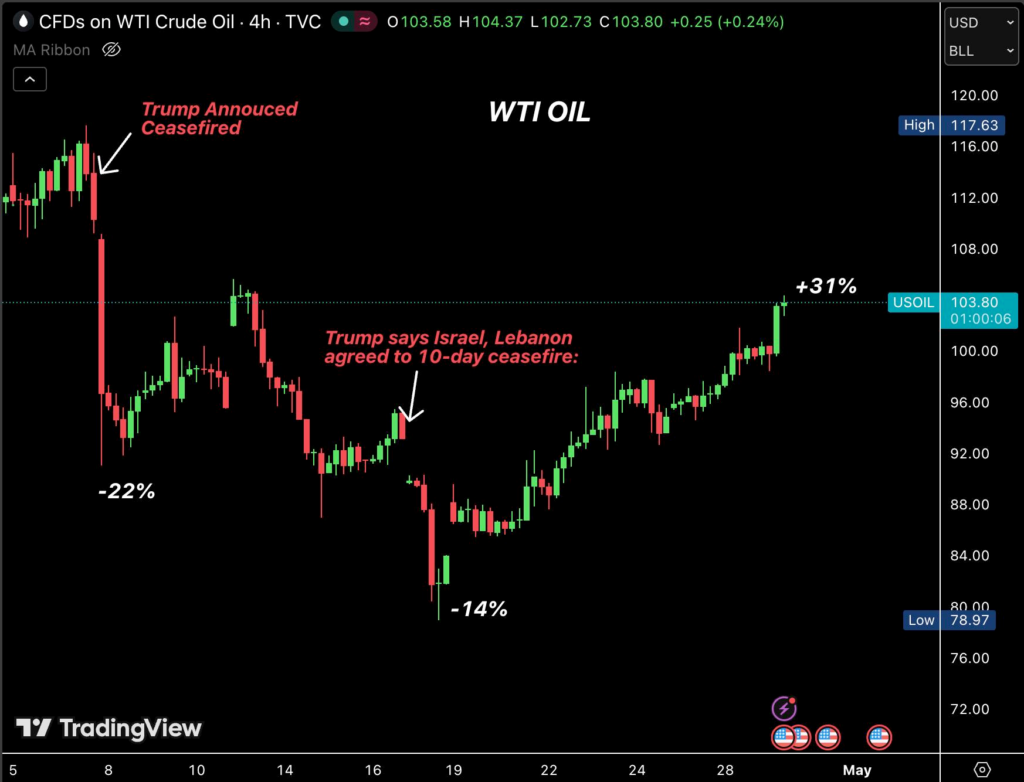
Charts show sharp swings across April trading sessions in global markets. Price movements followed policy announcements and shifting supply expectations. Market participants monitored storage data and shipping activity closely. Brent crude and WTI both reflected synchronized movement during the period. Futures markets reacted to both geopolitical and logistics updates. Speculative trading increased across short term contracts, as liquidity shifted across major trading hubs during the same period.
Iran Shifts Oil Exports Toward China Rail Routes
According to Crypto Rover, Iran shifting oil exports to China via railways bypass maritime pressure. The message linked rail transport with reduced maritime route pressure in trade. Observers said rail networks may reduce reliance on maritime transport corridors. Transport changes align with efforts to diversify export channels.
China continues to receive Iranian crude through expanded land logistics channels. Analysts track these flows as part of broader oil distribution changes. Oil trade routes between Middle East and Asia remain under observation. Market participants compare land and sea shipping costs regularly. Logistics firms adjusted schedules as rail and sea routes compete.
Energy analysts continue to track evolving Middle East trade corridors. Rail infrastructure expansion supports alternative crude delivery routes. Trade monitoring agencies track flows for pricing consistency. Long term contracts show cautious adjustments in pricing structures. Shipping data indicates steady rerouting across Eurasian corridors.