
TLDR
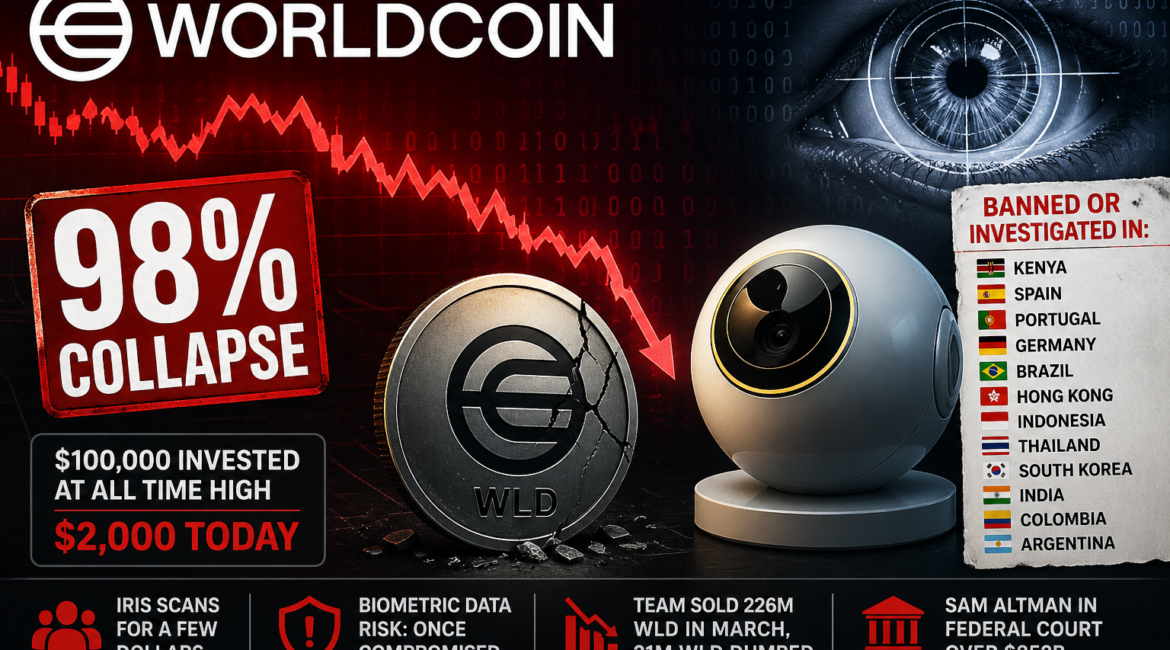
- Worldcoin recorded a steep 98% drop from its peak, raising concerns about its long-term token value.
- Reports claim millions of WLD tokens were sold during the decline, adding pressure on price stability.
- Daily token unlocks continue to expand supply, increasing dilution concerns among market participants.
- Several countries reviewed or restricted Worldcoin over concerns tied to biometric data collection.
A sharp decline in Worldcoin’s token value and rising scrutiny over its biometric data practices have intensified debate across the crypto sector. Recent claims circulating online have raised fresh questions about token economics, governance actions, and regulatory responses tied to the project.
Token Decline and Market Activity
A widely shared tweet from Bull Theory brought renewed attention to Worldcoin’s price performance. The post claimed that a $100,000 investment at peak valuation would now be worth about $2,000.
The same tweet outlined concerns about Worldcoin’s supply dynamics and ongoing token sales. It stated that 226 million WLD were sold through over-the-counter deals in March.
Additional claims noted that another 21 million WLD tokens were transferred to Bybit on April 25. These movements were described as occurring during a period of continued price decline.
At the same time, the tweet pointed to daily token unlocks of roughly 5.1 million WLD. This expanding supply has drawn attention to potential dilution pressures in the market.
Reports also referenced a projected unlock amount exceeding current circulating supply by a wide margin. This has fueled further discussion around long-term token distribution and valuation stability.
Meanwhile, secondary claims suggested that verified World accounts are being sold informally at very low prices. These reports remain unverified but have added to broader concerns around ecosystem integrity.
Biometric Data Concerns and Regulatory Response
The tweet also focused heavily on Worldcoin’s biometric data collection model. It described the Orb device, which scans iris data in exchange for token rewards.
Criticism cited in the post included remarks attributed to researchers and public figures. One referenced comment described the initiative as building a biometric database from vulnerable populations.
Another claim referenced public criticism comparing the process to cataloguing sensitive identity markers. These statements have circulated widely across social media discussions.
Regulatory responses have also been highlighted in the claims. Several countries were listed as having banned, restricted, or investigated Worldcoin’s operations.
Kenya was specifically mentioned, with reports stating that a High Court ruling required deletion of collected biometric data. The decision reportedly cited violations of privacy rights.
Brazil was also referenced as having banned the project, with authorities questioning whether financial incentives could ensure valid consent. This issue remains central to ongoing regulatory debates.
Other jurisdictions named in the tweet include Spain, Germany, India, and South Korea. These cases reflect a broader pattern of regulatory review across multiple regions.
Separately, the tweet mentioned legal proceedings involving Sam Altman. It referenced a federal court case tied to organizational structure and governance issues.
These claims, combined with market activity and regulatory scrutiny, have kept Worldcoin at the center of ongoing industry discussions. As developments continue, both token performance and compliance matters remain closely watched.