
TLDR
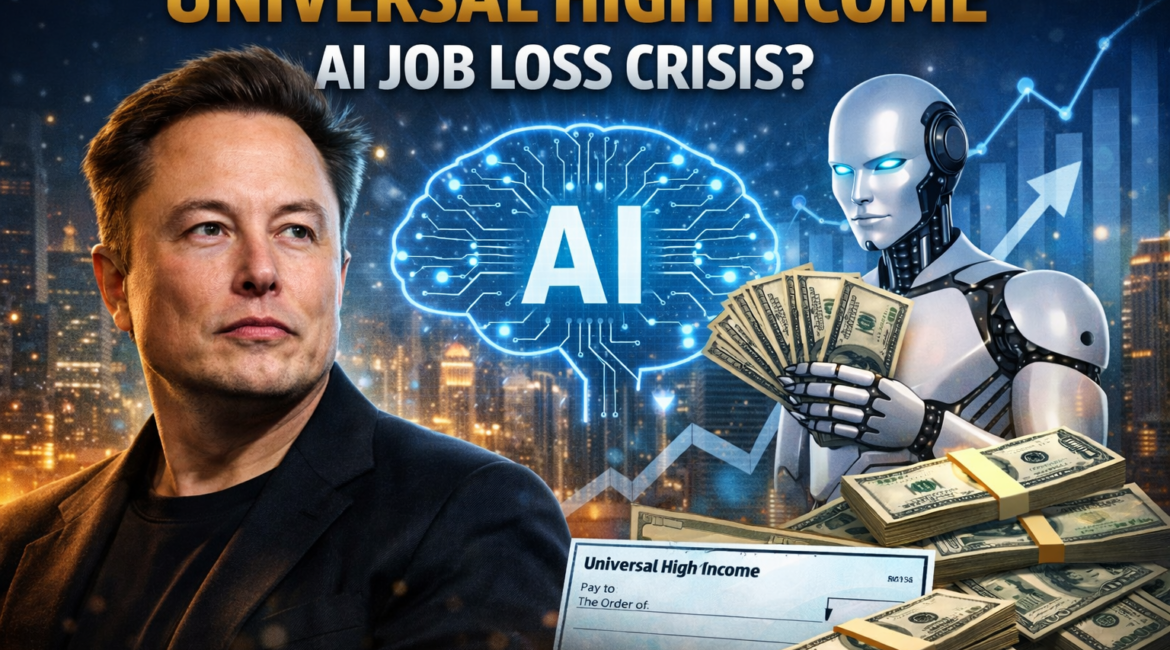
- Elon Musk Universal High Income model targets rising AI job loss across multiple industries globally.
- The plan focuses on higher income support instead of basic income for long-term financial stability.
- Musk states AI-led production growth may balance money supply and limit inflation concerns.
- Fast AI development is outpacing policy systems, pushing direct payments as a practical response.
Elon Musk has renewed debate on future income models, stating that government-issued payments may address AI-driven unemployment. His proposal centers on “universal high income,” arguing that rapid automation could sustain abundance without triggering inflationary pressure.
Musk’s Universal High Income Vision
Elon Musk recently shared views on X, suggesting direct payments as a response to job losses from automation. He described “universal high income” as more suitable than traditional universal basic income models.
The concept focuses on providing citizens with substantial financial support rather than minimal assistance.
According to Musk, AI and robotics could replace large portions of human labor across industries. As a result, employment may no longer serve as the main source of income for many individuals.
His proposal frames government-issued checks as a way to maintain financial stability during this transition.
In his statements, Musk pointed to a future where machines produce goods and services at scale. He argued that this surge in production could offset concerns tied to increased money circulation.
As a result, he maintained that inflation would not necessarily follow expanded government payments.
The idea differs from earlier income support systems, which often focus on basic needs. Musk’s version suggests a higher standard of living supported by advanced automation systems. This approach aligns with his broader outlook on a “positive AI future.”
AI Growth and Policy Challenges
Musk also discussed the pace of artificial intelligence development during a recent podcast conversation. He stated that AI could be advancing much faster than government systems can respond. This gap, he said, creates challenges for policymakers attempting to regulate emerging technologies.
During the discussion, other participants noted that current governance structures may struggle to match AI’s speed.
As a result, traditional regulatory approaches may not fully address economic disruptions. In this setting, direct financial support appears as a more immediate response.
Musk referenced earlier examples of government-issued payments, including pandemic-era stimulus checks. These measures, he noted, show that large-scale financial distribution is already possible. However, he acknowledged that long-term planning for such systems remains uncertain.
Beyond income support, Musk spoke about AI’s role in sectors like healthcare. He suggested that AI-powered systems could eventually match or exceed skilled professionals in certain fields.
This shift could reduce costs and expand access to advanced services worldwide.
At the same time, Musk dismissed the idea of a single dominant AI system controlling global operations.
He explained that multiple systems would likely function together due to physical and technical limits. This decentralized approach may shape how AI integrates into daily life.
While details around eligibility and funding remain unclear, Musk continues to promote direct payments as a workable solution. His statements reflect ongoing discussions about how economies may adapt to automation at scale.