
TLDR
- Nvidia (NVDA) stock rises as Codex expands across teams, improving workflow efficiency and reducing manual processes.
- Codex evolves into a full AI agent, handling complex tasks across engineering, legal, and operations teams.
- Nvidia integrates Codex with Blackwell systems, lowering costs while improving energy and output efficiency.
- Nvidia (NVDA) stock reflects investor interest as AI adoption expands within enterprise-level operations.
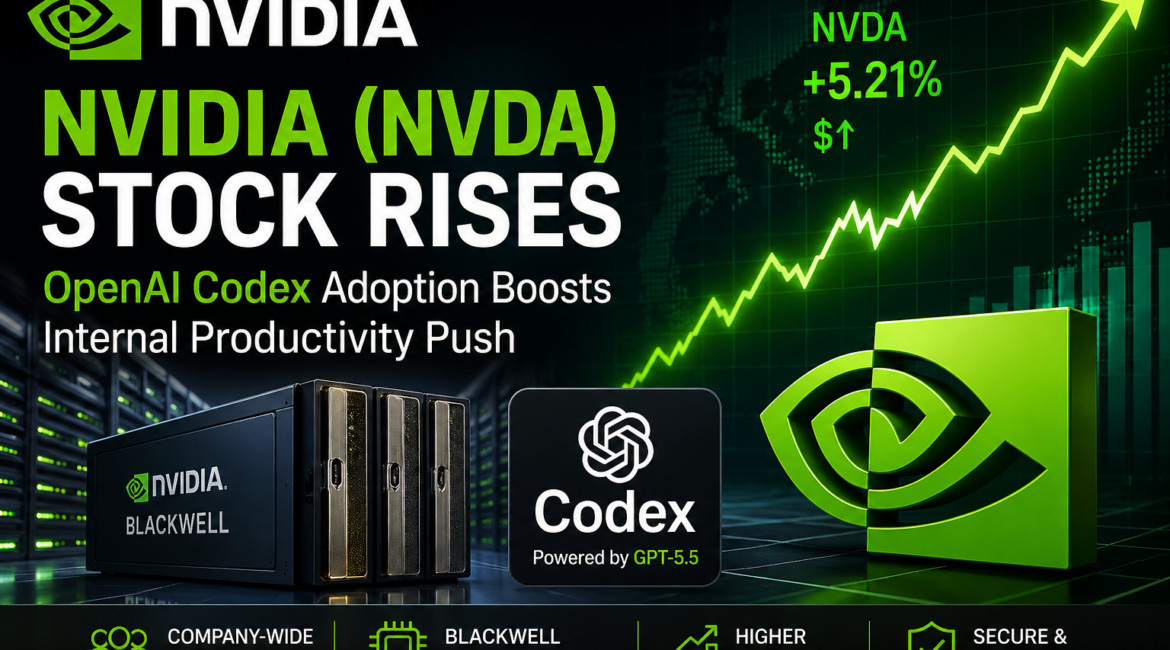
Nvidia (NVDA) stock recorded a steady climb after the company expanded OpenAI Codex across its global workforce. The move signals a wider internal shift toward AI-driven productivity, with Codex now supporting operations across engineering, legal, sales, and other departments.
Codex rollout reshapes internal workflows
Nvidia (NVDA) stock gained momentum as the company confirmed full deployment of Codex after a successful pilot. The trial involved around 10,000 employees and showed strong performance across different teams. As a result, the company moved forward with organization-wide adoption.
At the same time, public reactions surfaced online. A tweet shared by a major gaming outlet noted that employees described Codex as “mind-blowing” and “life-changing,” reflecting early internal sentiment. The tweet added visibility to Nvidia’s growing use of AI systems in daily operations.
Codex has moved beyond a simple coding assistant. It now functions as a full AI agent capable of handling structured workflows. Employees use it to plan tasks, generate code, and analyze internal processes. This shift marks a transition toward systems that complete tasks rather than respond to prompts.
Nvidia (NVDA) stock has also reflected investor confidence in this transition. The broader rollout suggests that the company sees long-term value in embedding AI tools across departments. In addition, Codex now supports product development, marketing strategies, and operational planning.
The system operates across multiple business units, allowing teams to integrate AI into routine tasks. This approach improves efficiency while reducing manual workload. As adoption expands, Nvidia continues refining how employees interact with AI tools in real-world settings.
Infrastructure and security drive performance gains
Nvidia (NVDA) stock has also benefited from the company’s ability to pair software with its own hardware. Codex runs on Nvidia’s Blackwell architecture, designed for large-scale AI workloads. This setup allows the system to deliver improved computational efficiency.
Internal data shows reduced cost per million tokens when running on GB200 NVL72 systems. At the same time, energy efficiency has improved, with better output per megawatt. These gains demonstrate how Nvidia integrates infrastructure with enterprise AI deployment.
Security remains a central part of the rollout. Nvidia has implemented a zero-data retention policy for Codex interactions. Employees access the system through controlled cloud-based environments, which limit exposure to sensitive systems.
The AI agent connects through secure channels and operates within approved environments. This setup allows Codex to assist with complex workflows while maintaining strict access controls. As a result, teams can use the system without risking critical infrastructure.
Another feature includes long-duration task execution. Codex can handle workflows that run for more than 24 hours. This is supported by a method called compaction, which maintains stable context over extended periods.
Nvidia (NVDA) stock continues to reflect growing interest in enterprise AI adoption. The company has also launched a dedicated Codex Lab to support training and system optimization. This initiative helps teams adapt the AI agent to specific operational needs.
The rollout also signals closer collaboration between Nvidia and OpenAI. Both companies continue working on infrastructure and system development. OpenAI provides feedback on future chip designs while accessing Nvidia’s system roadmap.
Nvidia (NVDA) stock remains closely tied to these developments. The company is positioning itself as both a hardware provider and a large-scale AI user. This dual role supports broader adoption of AI agents across enterprise environments.
As more organizations explore similar deployments, Nvidia’s approach offers a working model. The combination of infrastructure, security, and workflow automation continues to shape enterprise AI strategies.