

Key Insights:
- Long-term holders spent 15.2 million BTC during the current Bitcoin cycle period.
- The 2021 cycle remains record holder with over 15.3 million BTC distributed overall.
- Bitcoin cycles show rising LTH activity from 2013 through 2017 and beyond.
- Market depth growth allows smoother BTC transfers between old and new holders.
Bitcoin long-term holders recorded heavy coin movement across the latest cycle, according to on-chain data. The data shows that long-term holders (LTHs) spent large volumes of BTC from the bear market bottom to the bull market peak. However, the latest cycle did not set a new record for LTH distribution.
The total BTC spent by LTHs in the current cycle reached around 15.2 million BTC. This figure sits close to historical highs across previous market cycles. The analysis also notes that Bitcoin continues to show strong rotation between old and new holders.
Long-Term Holder BTC Spending Across Cycles
The data shows clear differences across Bitcoin market cycles. In 2013, long-term holders spent around 7.4 million BTC. In 2017, the figure rose to about 13.7 million BTC. According to Darkfost the 2021 cycle recorded the highest level at more than 15.3 million BTC. The current cycle stands near 15.2 million BTC.
These values reflect cumulative BTC movement from long-term holders during each full cycle. The measurement tracks spending from the market bottom to the cycle peak. It also shows how LTH behavior changes as Bitcoin grows in size and liquidity. Each cycle shows higher total activity compared to earlier periods.
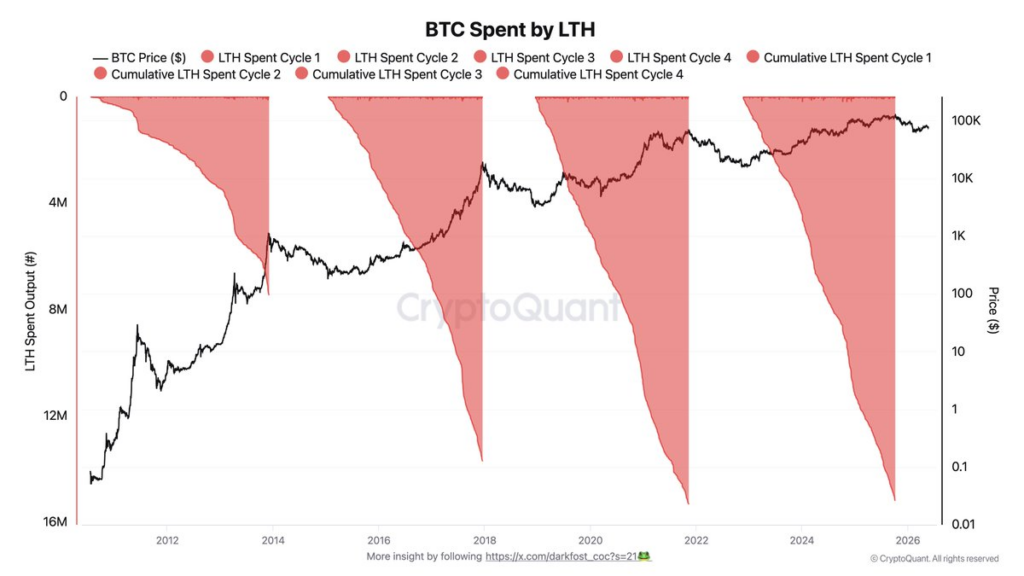
The methodology defines LTH coins as those inactive for more than six months. A single BTC can move between classifications over time. This means the same coin may be counted more than once in different phases. The structure of the metric can therefore affect total cycle comparisons.
Market Depth and Wealth Rotation in Bitcoin Cycles
However, data shows Bitcoin liquidity has increased over time. Higher market depth allows larger volumes of BTC to move with lower disruption. This enables long-term holders to distribute holdings across wider market participation. The 2021 and current cycles show the largest recorded rotations.
The analysis describes the process as a transfer of BTC between older and newer holders. Long-term holders reduce positions while new market participants absorb supply. This pattern repeats across cycles but scales with market growth. The data indicates stronger absorption capacity in later cycles compared to earlier ones.
This cycle structure supports smoother distribution phases during bull markets. It also reflects increasing participation across global Bitcoin markets. The movement of BTC between holder groups continues to define cycle behavior in on-chain metrics.