
TLDR
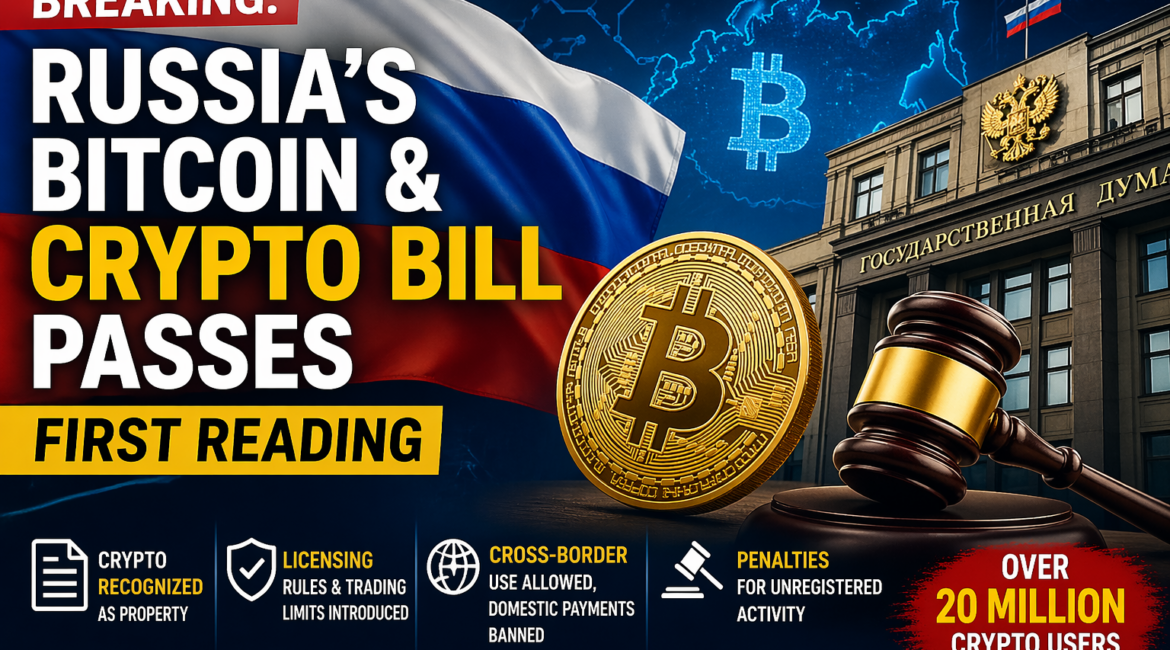
- Russia crypto bill recognizes cryptocurrencies as property, giving legal clarity to ownership and taxation rules.
- Russia crypto bill introduces licensing rules and restricts trading to approved participants under regulatory oversight.
- Russia crypto bill allows cross-border crypto use while banning domestic payments within the country.
- Russia crypto bill targets over 20 million users with structured rules to regulate market activity and compliance.
Russia’s lower house of parliament has advanced a new phase of crypto regulation after approving a key bill in its first reading. The move sets a legal foundation for digital assets while outlining trading limits, licensing requirements, and usage boundaries within the country.
Russia crypto bill sets legal framework for digital assets
The Russia crypto bill introduces formal recognition of cryptocurrencies as property under national law. This step provides legal clarity for ownership, taxation, and regulatory oversight across the country’s growing crypto market. At the same time, the proposal outlines stricter rules for market participation.
A widely shared tweet from Coin Bureau reported the development, noting that the State Duma approved the measure during its first reading. The tweet added that the Russia crypto bill includes licensing rules, trading restrictions, and penalties for unregistered crypto activity.
Under the proposal, only approved participants may engage in crypto trading activities. This includes both individuals and institutions that meet specific regulatory conditions. As a result, the framework aims to create a controlled environment for digital asset operations while maintaining oversight.
The Russia crypto bill also introduces penalties for those operating outside the approved system. Unauthorized trading or failure to comply with licensing rules may lead to legal consequences. These measures aim to reduce unregulated market activity and enforce compliance.
At the same time, the bill allows crypto use in cross-border transactions. This provision supports international trade settlements using digital assets. However, domestic payments using cryptocurrencies remain prohibited under the proposed rules.
Trading limits and adoption shape Russia crypto bill direction
The Russia crypto bill reflects the country’s large and active crypto user base, estimated at over 20 million individuals. This level of adoption has influenced the government’s approach toward structured regulation rather than a complete ban.
Trading limits are expected to play a central role in how users interact with the market. The bill proposes restrictions on who can trade and under what conditions. This includes potential qualification requirements for participants to access certain crypto services.
In addition, the Russia crypto bill establishes a licensing system for exchanges and service providers. Platforms operating within Russia would need official approval to offer services legally. This move aims to bring greater accountability to the sector.
Cross-border functionality remains a key feature within the proposal. Authorities appear focused on enabling international transactions while maintaining control over domestic financial activity. This dual approach reflects an effort to balance innovation with regulatory oversight.
ALSO READ:Cryptocurrency Market Jumps 1.97% as Bitcoin Crosses $77K Level
Meanwhile, the ban on domestic crypto payments reinforces the state’s position on preserving the national currency’s role. Digital assets may serve as investment tools or settlement instruments abroad, but not as everyday payment methods within Russia.
The Russia crypto bill is still in its early legislative stage. Further readings and revisions are expected before it becomes law. However, the first approval marks a clear step toward formalizing crypto activity within a defined legal structure.
As discussions continue, attention remains on how the final version will address enforcement, user access, and market participation. The Russia crypto bill now moves forward in the legislative process, with further debate likely in the coming sessions.