

Bitcoin is experiencing substantial selling pressure, with prices trending downward from the critical resistance level of $66,000.
Meanwhile, Bitcoin could dip below the psychological barrier of $60,000, approaching levels around $56,500 or the lows observed in May 2024. Despite this bearish outlook, some analysts maintain a positive long-term perspective.
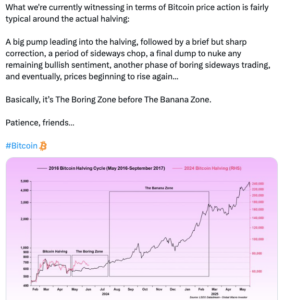
An analyst on X (formerly Twitter) suggests that the ongoing correction aligns with Bitcoin’s historical market cycles. According to the analyst, savvy traders should consider accumulating Bitcoin during these dips, expecting prices to reach new all-time highs in Q1 2024. The current price movement is consistent with trends observed in previous cycles, particularly following the halving events that reduce miner rewards.
Source: Julien Bittel, CFA on X
Impact of Halving on BTC Prices
Bitcoin is now in its fifth epoch after the most recent halving on April 20, which reduced miner rewards from 6.25 BTC to 3.125 BTC. This reduction has significantly impacted miner revenue streams and is a critical factor in the current market dynamics.
Historical data shows that Bitcoin prices tend to rise before halving events, as evidenced by the rally from October 2023 to March 2024, where prices surged from $25,000 to record highs. The demand surge was partly driven by the anticipation of the United States Securities and Exchange Commission (SEC) approving a spot BTC exchange-traded fund (ETF), which started trading in January 2024.
Following the pre-halving rally, Bitcoin experienced a sharp correction, dropping by 25% to a low of $56,500 in May. Currently, Bitcoin is in what analysts describe as the “Boring Zone,” characterized by minimal price volatility and an extended consolidation phase.
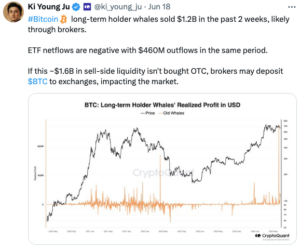
Ki Young Ju, founder of CryptoQuant, notes that large Bitcoin holders, or whales, have been selling BTC over the past two weeks. On-chain data indicates that these long-term holders have sold approximately $1.2 billion worth of Bitcoin, likely through brokers rather than on the open market, which has put downward pressure on prices. The outflows from spot Bitcoin ETFs have also contributed to slowing the uptrend.
Source: Ki Young Ju on X
Miner Behavior and Market Activity
The behavior of Bitcoin miners has also shifted in response to the reduced rewards from the recent halving. Some miners are reportedly moving towards the artificial intelligence (AI) sector, which relies on powerful computing resources. This shift is partly driven by the need to find alternative revenue streams, as noted by Lucy Hu, senior analyst at Metalpha. She explains that AI firms’ demand for energy-intensive data centers is providing new opportunities for Bitcoin miners.
Since June 5, Bitcoin prices have declined from $71,000 to just over $65,000, influenced by a strong U.S. dollar, a shift away from riskier assets, and growth in traditional stock indices. Additionally, U.S.-listed ETFs tracking Bitcoin have recorded net outflows exceeding $600 million in the past week, marking their worst performance since late April.