

As the cryptocurrency giant grapples with fluctuating market conditions, Bitcoin has struggled to maintain its earlier gains, facing stiff resistance at $65,000 and sliding to a significant low of $61,700. This recent downturn underscores the heightened volatility and bearish sentiment pervading the crypto market, influenced heavily by the underperformance of newly listed Bitcoin ETFs and prevailing macroeconomic uncertainties.
Bitcoin price analysis shows that the cryptocurrency is struggling to sustain its momentum after a brief surge above $67,000 earlier in the week. The digital currency encountered substantial selling pressure, which led to a significant drop, failing to maintain stability and sliding to a ten-day low of $61,700. This indicates a volatile market where Bitcoin is testing key psychological levels.
#BTC Monthly close incoming: pic.twitter.com/0SG99S5Rqs
— Matthew Hyland (@MatthewHyland_) April 30, 2024
The sell-off was fueled by disappointing performances in the ETF sector, particularly with the new ETFs listed in Hong Kong, which saw much lower trading volumes than expected. This underperformance contributed to a bearish sentiment, as Bitcoin dropped nearly 2% within an hour during the European trading hours, falling under the $61,000 mark. Concurrently, Ethereum also witnessed a decline, shedding 2.8% to reach $3,066, further indicating broader market uncertainties.
For instance, while Bitcoin ETFs in the U.S. saw a first-day tally of $655 million in January, the Hong Kong ETFs only reached $11 million, far below the anticipated $100 million. This stark contrast has played a critical role in the recent price corrections observed in Bitcoin’s market.
Additionally, the global macroeconomic environment continues to inject volatility into the cryptocurrency market. Factors such as inflation rates, monetary policies by major central banks, and geopolitical tensions are closely watched by investors, as these can significantly sway market sentiment and trading behavior.
Bitcoin Technical Indicators and Price Movements
From a technical standpoint, Bitcoin is currently consolidating within a narrow range, indicating uncertainty among traders. The significant resistance level is set at $65,600, which Bitcoin has struggled to breach convincingly. The Relative Strength Index (RSI), a momentum oscillator used to measure the speed and change of price movements, suggests that Bitcoin is not yet in the oversold territory, implying that there could be more room for downward movement.
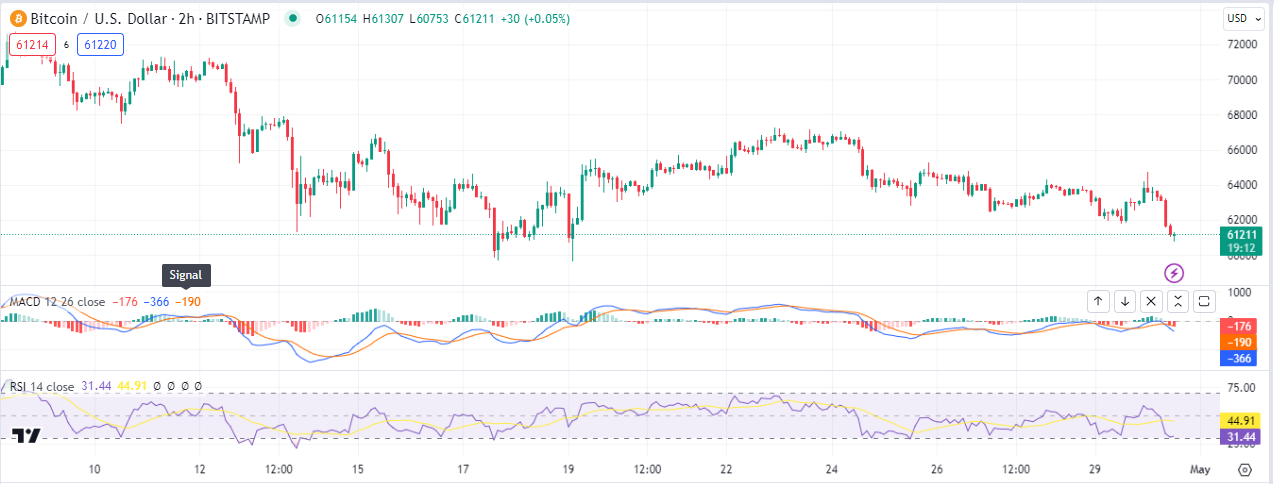
The Moving Average Convergence Divergence (MACD), a trend-following momentum indicator that shows the relationship between two moving averages of a security’s price, is also indicating bearish momentum. The MACD histogram is expanding in the negative zone, and the signal line is trending downwards, reinforcing the bearish outlook in the short term.
BTC’s Current Trading Levels and Outlook
The immediate concern for Bitcoin traders is the potential break below the $60,000 support level. A breach below this point could trigger further losses, potentially extending down to $53,000, aligning with the lows of April 13. This scenario would represent a critical test of Bitcoin’s resilience in a bearish market.
Read Also: The Fourth Bitcoin Halving and the Future of Cryptocurrency Mining
On the contrary, if Bitcoin can reclaim and stabilize above the $63,000 level, it may attempt to challenge the upper resistance once more. Successfully holding gains above this threshold could lead investors to test the $65,000 resistance again. However, for a significant trend reversal, sustained buying pressure and positive market news would be essential to drive prices higher.
Bitcoin is currently at a crucial juncture, facing significant technical resistance and bearish market sentiment influenced by underperforming ETFs and macroeconomic uncertainty. Traders should keep a close eye on the $60,000 support level, as a break below this could set the tone for the trading days ahead. Meanwhile, potential recoveries will depend on the ability to sustain levels above recent lows, with market sentiment and external economic factors continuing to play pivotal roles.