

Explore an in-depth Bitcoin price analysis following the halving event, focusing on the key trends, trading volumes, and expert insights that shape the cryptocurrency market.
Bitcoin has shown a slight price increase in the last 3 hours, rising from an intraday low of $62,783.63 to the recent trading price of $64,056.39. Despite the recent surge, the cryptocurrency experienced a drop of over 2.5% Thursday morning, influenced by the downturn in tech stocks. The recent Bitcoin halving has brought both heightened volatility and market attention.
Despite stagnant prices, institutional investors are optimistic, evidenced by increased ETF trading volumes. Whale accumulation suggests long-term confidence. However, on-chain data indicates declining profitability for most addresses, with a falling Long/Short difference indicating more long-term holders. Daily active addresses declined, signaling reduced ecosystem activity.
BTC’s price trended slowly bullish but struggled to surpass $67,238. It dipped below the 50-period moving average, indicating a downward trend. The Bull Bear Power indicator dipped below the neutral level, and the pair broke below the descending trendline. A continued fall is anticipated, with $60,000 being the next crucial support level.
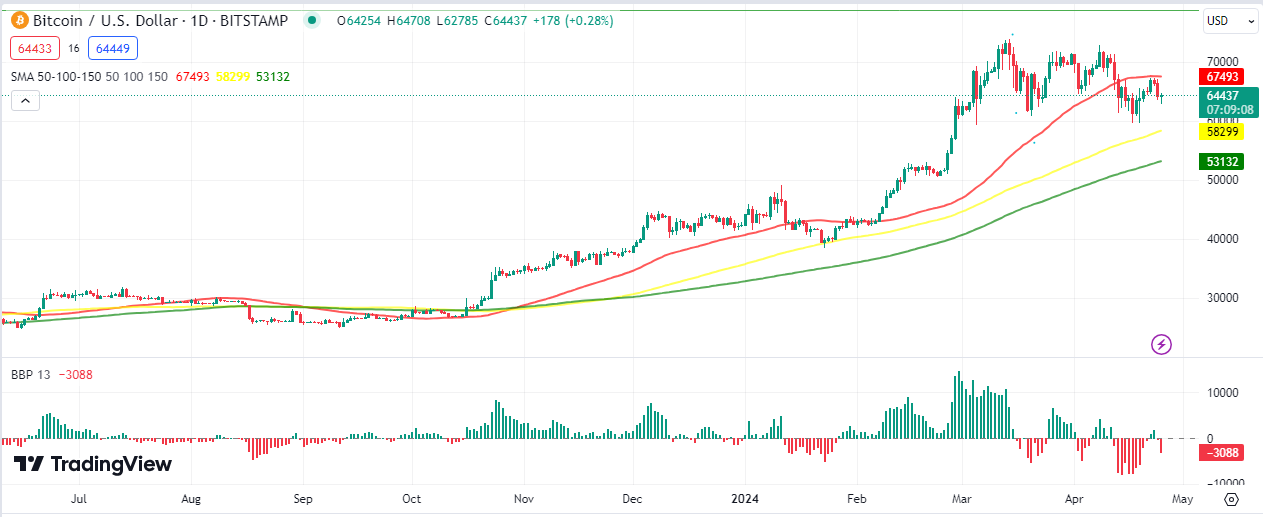
After the Bitcoin halving, which reduced the mining reward from 6.25 to 3.125 BTC, the price initially soared, celebrating this milestone. However, the excitement has tempered as Bitcoin has shed nearly 10% of its value over the past month. This decline coincides with a broader dip in tech stocks, contributing to Bitcoin’s fall below $64,000 on Thursday morning.
In contrast to the price drop, Bitcoin’s trading volume has surged by 36%, indicating increased trading activity despite the falling prices. This could suggest that while some investors are selling, others are buying the dip, viewing the lower prices as a buying opportunity.
BTC Price Analysis: Active Profit-Taking and Declining ETF Investments
Bitcoin’s price fell to lows of $62k following active profit-taking and decreased investments in bitcoin exchange funds. The failure of the BlackRock Bitcoin fund to attract investments led to a sudden drop in cash flow, contributing to the decline.
🚨 $BTC #ETF Net Inflow Apr 23, 2024: +$32M!
• The net inflow has been positive for 3 consecutive trading days.
• The single-day outflow of #Grayscale Bitcoin Trust $GBTC remains under $100M for 4 trading days in a row.
• Generally, all 10 #Bitcoin #ETFs, especially… pic.twitter.com/puqBk8faGv
— Spot On Chain (@spotonchain) April 24, 2024
BTC’s recent decline reflects a broader trend influenced by macroeconomic factors and on-chain metrics. Despite rising interest in Bitcoin ETFs and whale accumulation, declining daily active addresses signal reduced ecosystem activity. This, combined with external factors like economic reports and Federal Reserve actions, contributes to BTC’s current downward trajectory.
Institutional Confidence vs. On-Chain Activity
While institutional investors express confidence through increased ETF trading volumes and whale accumulation, on-chain metrics reveal challenges. Most addresses are not profitable, and declining daily active addresses suggest reduced network engagement. This dichotomy highlights the complexity of BTC’s market dynamics.
BTC’s performance is closely tied to macroeconomic factors, such as US economic reports and Federal Reserve actions. The upcoming GDP estimate and PCE inflation report will likely influence investor sentiment and BTC’s price trajectory. A stronger PCE figure could lead to a hawkish Federal Reserve stance, impacting BTC’s performance negatively.
Ali Martinez gives an Insightful Analysis of Bitcoin’s Price Movements and Future Trajectories
A comprehensive analysis, drawing insights from the observations provided by Ali Martinez, a seasoned technical and on-chain analyst, sheds light on BTC’s recent price movements and potential future trajectories.
The TD Sequential indicator has flashed a sell signal on the 12-hour chart, with #Bitcoin facing resistance at the mid-level of a parallel channel!
Exercise caution, given this indicator's track record. Particularly watchful if $BTC drops below the $65,500 support level. pic.twitter.com/m7iquoi1L5
— Ali (@ali_charts) April 24, 2024
Ali’s analysis reveals the significance of technical indicators in deciphering BTC’s price dynamics. Notably, the TD Sequential indicator recently issued a sell signal on Bitcoin’s 12-hour chart, signaling a potential shift in market sentiment towards a bearish stance. This observation underscores the importance of vigilance and risk management strategies among market participants.
Key resistance levels identified by Ali serve as critical checkpoints for BTC’s price trajectory. Notably, a formidable resistance zone spanning from $70,180 to $70,600 presents a substantial barrier, backed by on-chain data indicating significant selling pressure from a multitude of BTC addresses. Overcoming this resistance band poses a notable challenge for BTC’s upward momentum.
Conversely, Ali highlights essential support levels crucial for gauging BTC’s price action. These levels, situated at $61,100, $56,685, and $51,530, serve as key inflection points where market sentiment may shift, presenting opportunities for strategic positioning and decision-making among traders and investors.
In addition to resistance and support levels, Ali’s analysis identifies a potential bullish breakout pattern emerging as Bitcoin seemingly breaches an ascending triangle formation on lower time frames. This pattern suggests a plausible scenario for BTC’s price to ascend in the near term, offering optimism for bullish market participants.
Beyond technical indicators, Ali underscores the enduring bullish narrative surrounding the Bitcoin halving event. Despite the focus on short-term price movements, Ali emphasizes the profound impact of the halving cycle on BTC’s long-term value appreciation, highlighting the importance of considering macroeconomic factors in investment strategies.
Lark Davis Insights on the current Crypto Market Sentiment
Another market expert Lark Davis offers a broader perspective on the current state of the Bitcoin market, observing a period of consolidation amidst a generally bearish sentiment as reflected by the discussions on Crypto Twitter.
The crypto market is quiet as Bitcoin continues a period of consolidation.
Crypto Twitter continues to be bearish.
Meanwhile:…
— Lark Davis (@TheCryptoLark) April 25, 2024
He points to significant upcoming events that could inject new energy into the market, such as the start of trading Hong Kong ETFs and increased activity in major Asian markets including Japan, Singapore, South Korea, and mainland China.
The involvement of major financial entities, like Morgan Stanley, which is now allowing its 15,000 brokers to recommend Bitcoin ETFs, underscores the growing acceptance and institutional interest in Bitcoin. Additionally, the continuous purchase of Bitcoin by ‘whales’ suggests a strong belief in the long-term value of Bitcoin, further influencing the market dynamics.