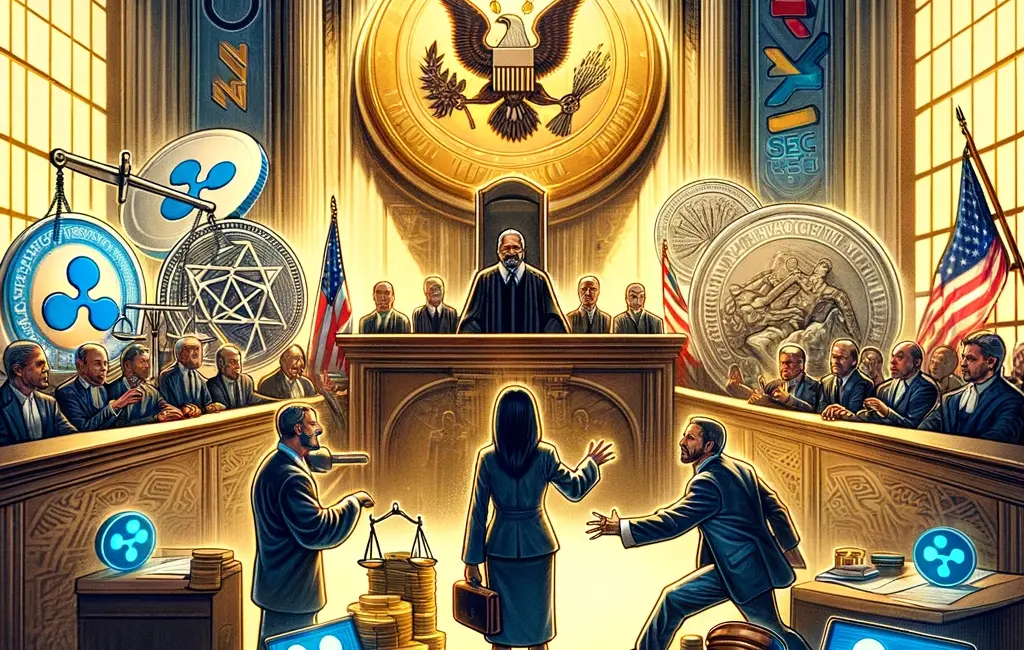
The U.S. Securities and Exchange Commission (SEC) is seeking a nearly $2 billion fine from the cryptocurrency firm Ripple. This action comes after the SEC was successful in some of its claims regarding Ripple’s illegal sale of securities. Specifically, the SEC is asking for over $1.95 billion in penalties from Ripple as a result of these findings.
Ripple Labs is currently facing a pivotal challenge as the United States Securities and Exchange Commission (SEC) proposes a staggering $2 billion fine against the company. This development is a critical juncture in the ongoing legal battle between Ripple and the SEC, drawing intense scrutiny and debate within the cryptocurrency and financial industries.
#XRPCommunity #SECvRipple My Updated Thoughts:
Well, shoot. I was hoping SEC was moving on to other pastures but I guess not. There is still a chance that SEC eventually concedes after the final order on damages (remember that's probably coming mid-summer) but I'm starting…1/5— Fred Rispoli (@freddyriz) February 6, 2024
The SEC’s Stance and Ripple’s Response
Ripple Labs, the entity behind the XRP cryptocurrency, has been embroiled in a legal tussle with the SEC, which has now escalated with the regulator’s recent fine request. Stuart Alderoty, Ripple’s Chief Legal Officer, criticized the SEC’s approach, viewing it as an attempt to intimidate and penalize Ripple and the wider crypto industry unjustly.
Echoing Alderoty’s sentiments, Ripple CEO Brad Garlinghouse has strongly opposed the SEC’s demand, pointing out the absence of fraud allegations in the request and pledging to vigorously contest the regulator’s actions.
This latest action by the SEC is part of a series of escalating tensions between the regulator and Ripple, further complicated by Garlinghouse’s references to the SEC’s actions in other cases, such as the DEBT Box incident. Despite the SEC’s silence on specific matters, the unfolding situation has caught the attention of legal experts and industry observers.
One such expert, Fred Rispoli, suggests there’s a 40% chance of a significant twist in Ripple’s legal narrative, highlighting the complexity of proving investor harm—a central contention in Ripple’s defense.
Potential Outcomes and Crypto Industry Impact
The SEC’s request for a $2 billion fine marks a significant moment not just for Ripple but for the cryptocurrency industry at large. The case raises crucial questions about the future of XRP sales to institutional buyers and the broader implications for the crypto market. Rispoli outlines potential scenarios, including a favorable post-judgment settlement for Ripple or an extended legal battle that could affect the company’s operations and market position.
Read Also: ETFS Capital Advocates for Strategic Overhaul at WisdomTree
The outcome of this legal confrontation between Ripple and the SEC is poised to influence regulatory actions against other crypto companies and shape the landscape of digital currencies and blockchain technology. Investors and industry stakeholders are watching closely, hopeful for a resolution that fosters innovation while providing regulatory clarity.
As Ripple prepares to navigate through these challenging times, the cryptocurrency community, regulatory bodies, and investors are all keenly interested in the case’s outcome. The resolution of Ripple’s legal challenges has the potential to set precedents for future regulatory engagements with the crypto industry and play a significant role in shaping the regulatory framework for digital currencies.
Ripple vs. SEC: The Ongoing Crypto Regulatory Saga
The legal confrontation between the U.S. Securities and Exchange Commission (SEC) and Ripple Labs, a leading name in the cryptocurrency sphere, has been a focal point for discussions around the regulation of digital assets. Initiated in December 2020, the SEC’s lawsuit against Ripple, along with its CEO Brad Garlinghouse and co-founder Christian Larsen, was based on allegations of conducting a $1.3 billion unregistered securities offering through their sale of XRP tokens.
The trajectory of this case saw a significant development in July 2023 when Judge Analisa Torres ruled that XRP, when sold on cryptocurrency exchanges, did not qualify as a security. This ruling not only marked a pivotal moment for Ripple but also set a precedent that could influence the regulatory approach toward other cryptocurrencies.
Following Judge Torres’s decision, the SEC, in October 2023, retracted its charges against Garlinghouse and Larsen, although it continues to press legal actions against other major players in the crypto industry, including Coinbase, Binance, and Kraken. This persistent scrutiny underscores the SEC’s commitment to regulating the crypto market, despite facing criticisms and challenges regarding its authority and methods.
Ripple’s ongoing defense against the SEC’s substantial $2 billion fine proposal signifies the intense legal and regulatory uncertainties currently surrounding the crypto industry. Ripple’s response is anticipated with keen interest, especially after a separate incident where a Utah judge accused the SEC of “bad faith” in its handling of evidence in a case against Debt Box, hinting at deeper systemic issues within the regulatory body.
Our response will be filed next month, but as we all have seen time and again, this is a regulator that trades in statements that are false, mischaracterized and designed to mislead. They stayed true to form here. 2/4
— Stuart Alderoty (@s_alderoty) March 25, 2024
CEO Brad Garlinghouse’s outspoken critique of the SEC’s fine request emphasizes Ripple’s determination to challenge the SEC’s actions and motivations openly. This legal struggle not only affects Ripple and its XRP token but also has broader implications for investor sentiment and the regulatory landscape governing digital currencies.
XRP Price Movements and Market Sentiment
From a technical perspective, XRP’s trading dynamics offer a glimpse into the market’s reaction to these legal developments. As of the latest data, XRP is trading at $0.634330, experiencing a 2.5% decrease over the past 24 hours, with a trading volume of $2.1 billion. Despite these fluctuations, XRP maintains a strong market position, ranked 6th by market capitalization at $34.7 billion, and a circulating supply of approximately 54.88 billion coins.
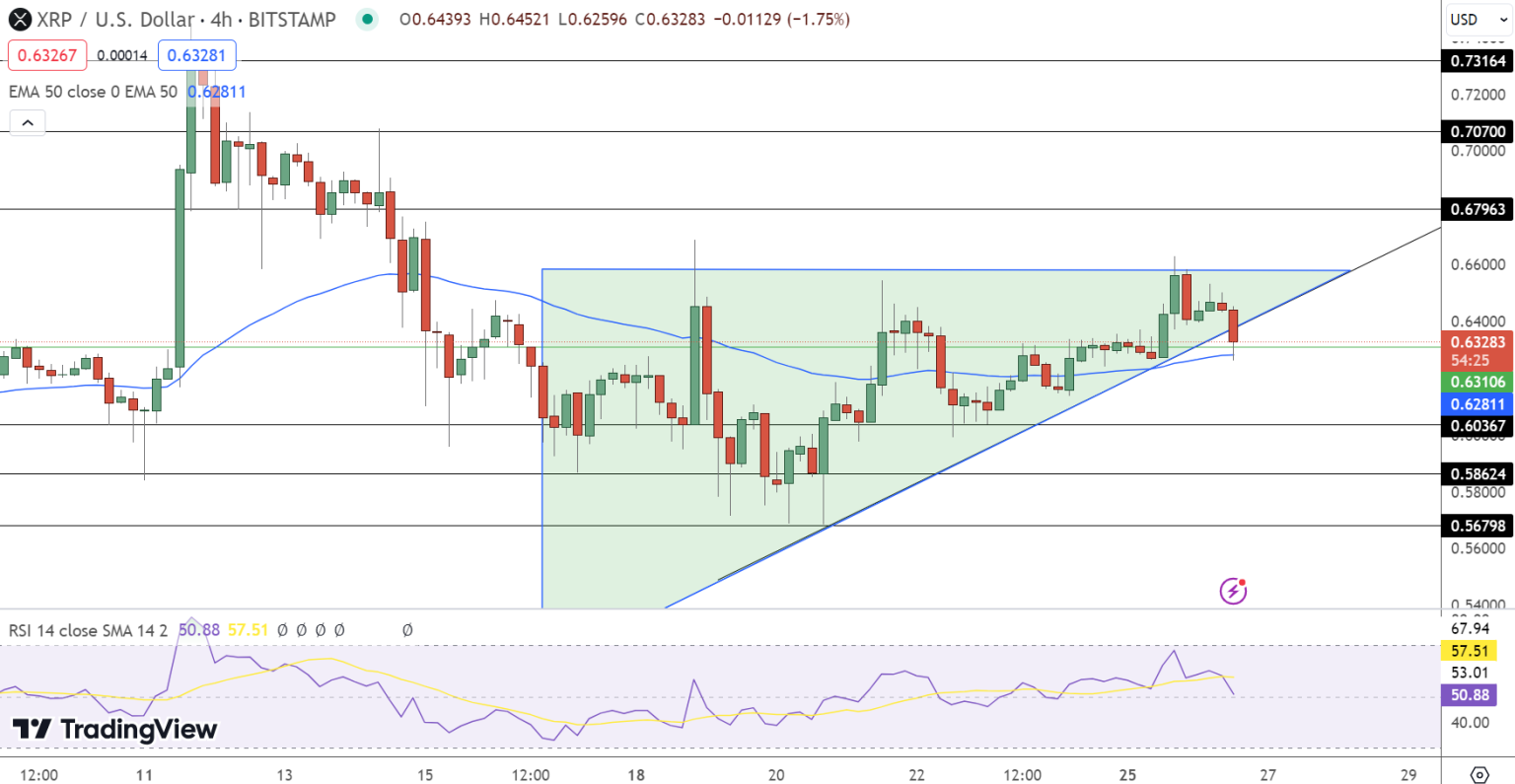
The technical analysis highlights a potential pivot point at $0.63106, with resistance and support levels indicating the market’s bullish sentiment, as evidenced by the RSI at 59 and the 50 EMA at $0.62799. An ascending triangle pattern on the four-hour chart suggests a potential for upward momentum, reflecting the market’s resilience and optimism amidst regulatory uncertainties.
Ripple’s legal entanglement with the SEC is more than a mere corporate dispute; it is a landmark case that could define the future of cryptocurrency regulation. As Ripple prepares to counter the SEC’s penalty proposal, the outcome of this battle will likely have far-reaching implications for the crypto market, shaping regulatory practices and investor confidence in the evolving landscape of digital currencies.