
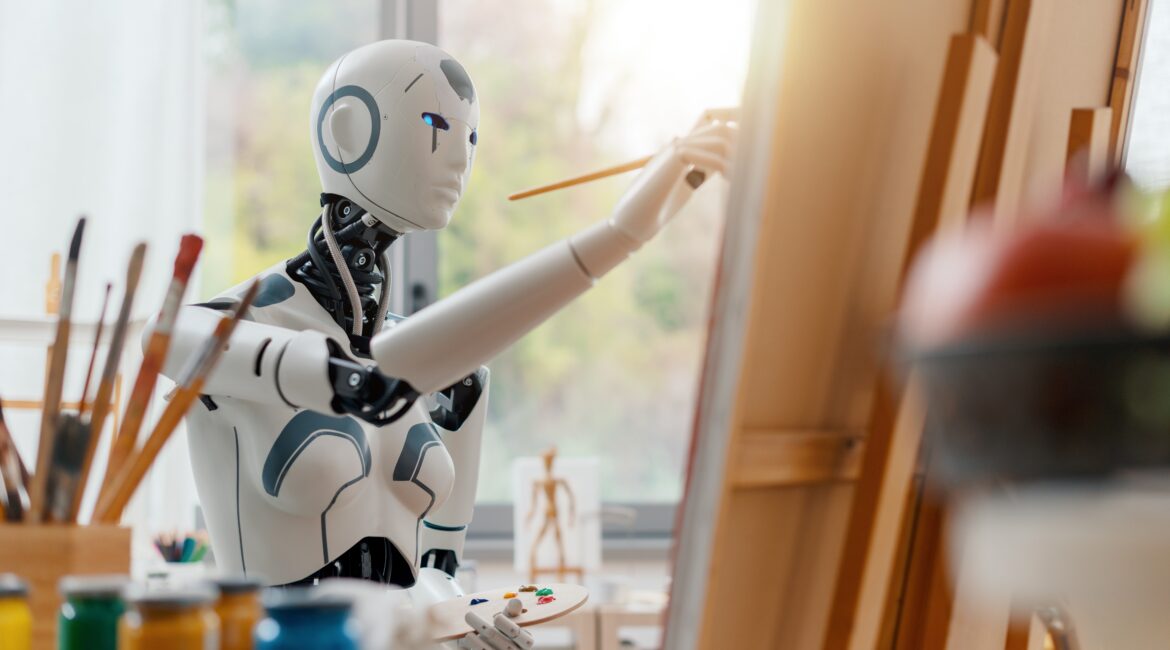
In recent years, there has been a noticeable surge in the development and application of artificial intelligence (AI) technologies.
This TechTinypen guide aims to elucidate the nature of AI art, its operational mechanisms, and its potential to augment creative expression and efficiency in various workflows.
What is AI?
Artificial Intelligence encompasses creating and implementing computer systems and algorithms capable of executing tasks traditionally performed by humans. These systems undergo training with extensive datasets, enabling them to learn, reason, address problems, and make decisions potentially exceeding human capabilities. AI encompasses a range of technologies, including machine learning, natural language processing, and image generation.
Through data analysis, pattern recognition, and iterative learning, AI systems are designed to learn, adapt, and automate tasks, thus facilitating the delegation of certain activities from humans to machines. Anticipated to drive progress across various sectors such as healthcare, finance, transportation, and creative fields, including website and graphic design, AI stands at the forefront of technological advancement.
What is AI Art?
AI art, also known as generative AI, involves leveraging artificial intelligence to facilitate art creation, assisting in everything from image generation to creative writing, music composition, and website creation. Distinct from traditional digital art crafted by individuals with artistic skills, AI art enables those lacking in artistic proficiency to produce a broad array of art forms using simple text prompts.
History of AI Art
The concept of AI art is not a recent phenomenon, tracing back to the 1960s with the development of the Aaron program by British artist Harold Cohen. This program, capable of generating art independently, garnered significant attention for both the technology and its creator. In July 2015, Google LLC introduced DeepDream, a tool employing a neural network to identify and amplify image patterns, followed by the release of a text-to-image tool allowing AI art creation through text prompts.
Subsequent innovations have included tools utilizing GAN models to analyze existing art and generate new pieces. A key development was Ganbreeder, an AI tool enabling the creation of new images from existing ones, utilizing the vast repository of images worldwide for AI art development.
However, it was only in the early 2020s, with AI tools like ChatGPT’s increased visibility, that AI art gained significant traction, empowering individuals to explore creative avenues in writing, music, and art.
Generating AI Art
Embarking on the creation of AI art involves several steps:
- Selecting an AI art generator: With numerous platforms available, it is crucial to research and compare to identify the most suitable option. After choosing a platform, the next step is to create an account.
- Crafting your prompt: Precision in your text prompts is vital. Unlike human interaction, machine work requires detailed and explicit instructions to achieve the desired outcome. Therefore, your prompt should include specific information regarding the art type, subject, subject details, style, and perspective. For example, rather than requesting “a picture of a beautiful house,” a more effective prompt would be, “Create an illustration of a mid-20th century American house with two stories and a spacious lawn, depicted in a minimalist style.” Experimentation with various prompts and familiarization with the tool is encouraged to refine outcomes.
- Downloading your art: Once your artwork has been generated, you can download and share it as desired.
Varieties of Artificial Intelligence Art Applications
Currently, several artificial intelligence (AI) art applications are available, each relying on distinct computational models:
- Generative Adversarial Networks (GANs): These applications utilize a synthesis of neural networks and deep learning algorithms to generate art in response to user prompts. When a prompt is provided, a GAN-based application forecasts the art’s appearance before creating it. Examples include ARTGAN and MidJourney.
- Recurrent Neural Networks (RNNs): RNNs produce sequences by analyzing previously inputted data. Implementations of this model can be seen in NightCafe, alignDRAW, and Apple’s Siri.
- Neural Style Transfer (NST): NST applications can replicate the artistic style of one image onto another, creating a new piece of art. Tools such as Fotor and Neural Style Transfer utilize this approach.
- Convolutional Neural Networks (CNNs): Applications like DeepDream fall into this category, identifying and transforming objects in existing images into new artistic creations.
Artificial Intelligence Art Versus Traditional Human Art
The rise of AI-generated art has sparked discussions about its ethical implications and authenticity. Traditional art, crafted by humans, reflects personal intuition, experiences, and emotional depth. In contrast, AI art is the product of algorithms, mathematical models, and machine learning techniques.
As society becomes more familiar with AI-generated art, distinguishing it from human-created art has become more accessible, leading to speculation about the lasting appeal of AI-generated works.
Controversies Surrounding AI Art
The advent of AI art has not been without controversy, especially among traditional artists questioning its legitimacy as “true” art. Some view AI art as a shortcut for those needing more talent or dedication to create art independently.
Moreover, an incident where an AI-generated piece won an art competition has fueled ongoing debates about the role and recognition of AI in the art world. Despite the advantages of AI art, such as efficiency and accessibility, concerns about its impact on human artists’ livelihoods and the potential for copyright infringement persist.
Illustrations of AI-Generated Art
AI-generated art has showcased its versatility in recent years, ranging from reimagined classic paintings to personalized portraits and even speculative depictions of historical figures in unusual contexts. Noteworthy examples include “Keep Running” by James She, a series of GAN-produced horse paintings from the COVID-19 lockdown, and “The Next Rembrandt,” a 3D painting generated by AI in collaboration between Delft University of Technology, Microsoft, and the Museum Het Rembrandthuis.
Conclusion
AI-generated art is poised to be a significant and polarizing movement in the art world of the 21st century. While opinions vary on its value and impact, the technology behind AI art is here to stay, promising further exploration and expansion of its creative boundaries.
Editorial Credit: Shutterstock